 Important Announcement:
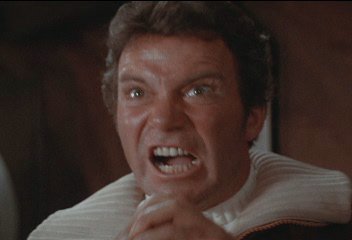
Starting immediately, I'm calling for a moratorium on the Wrath of Khan analogy. You can blame Bryan Singer -- he ruined it for everyone.
At this summer's San Diego Comic Con, Singer used the analogy to indicate that the follow-up to Superman Returns would have more action. "I plan to get all Wrath of Khan on it," he announced, then later explained himself to TODAYonline:
"What I was referring to was the fact that, when you do a first film like X-Men, for example, you're introducing a world and a set of characters. Once those characters are introduced, once we've lived with them for awhile and we know them, when you get into a second film like an Empire Strikes Back or a Wrath of Khan, you can make an action-adventure film and you don't have to bank all that time getting to know the characters. Now you can raise the stakes, raise the jeopardy and make a leaner, meaner movie."I call bullshit.
This is Superman that Singer is talking about, an icon who needs no introduction. Superman and his supporting cast have been around for almost 70 years now, and in that time they've been adapted from the comics into numerous movies and television series, both animated and live action -- not to mention other media, such as radio shows, novels, and newspaper strips. The television season immediately preceding Superman Returns' summer box office premiere included on its schedule both the WB's Smallville and Cartoon Network's Justice League Unlimited. I don't think the intervening weeks were enough to allow Superman to drop out of the public consciousness.
And it's not like Singer had a bold new vision of the Superman mythos that the audience would need time to adjust to. Superman Returns was basically a revival of the Christopher Reeve movie series with a new cast and state-of-the-art special effects. Honestly, I think the movie could have started off with an aerial slugfest over Metropolis between Superman and Bizarro, and the audience would have managed to keep up.
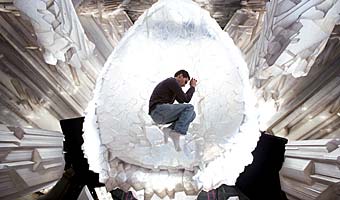 Describing the TODAY interview, Mark Beall over at Cinematical writes that Singer "simply pointed to traditional comic book movie wisdom, and said he meant the first movie had to be consumed with character introductions and relationships, the second movie -- like the old Wrath of Khan -- could jump right into the action." Beall went on to conclude, "He's right, of course, with the conventional wisdom he suggested..."
And that's what I'm talking about. I'm not really attacking Bryan Singer, who still has a lot of street cred with me for what he accomplished on the X-Men movies, but the conventional wisdom that his comments stem from. His usage of the now-common Wrath of Khan analogy was simply the spine-snapping straw responsible for the quadriplegic camel.
Because it's an analogy I hear constantly, every time a new comic book movie franchise kicks off and the fans feel the need to defend the lackluster results. They repeat this assertion that the point of the first movie is to get the characters' origins out of the way, and then the real fun can begin in the second one. My problem with this conventional wisdom is that it is essentially describing a television pilot, not a movie.
The first episode of a TV series is supposed to establish the characters and their world for the audience. A movie is supposed to be a complete package that can stand alone on its own merits.
After all, not every successful movie launches a franchise, which means that the characters, world, and action all have to be crammed into one story. It can be done. Blade Runner, Titanic, The Thing, Fight Club, Pulp Fiction, Saving Private Ryan, The Treasure of the Sierra Madre, Braveheart... all one-offs.
And what about action heroes who do return in sequel after sequel? Should Indiana Jones, Martin Riggs, or John McClane have had slow, plodding introductory movies before their action-packed debuts in Raiders of the Lost Ark, Lethal Weapon, or Diehard? Should Dr. No have presented the audience with more biographical data on 007 before launching the James Bond franchise?
What I find truly ironic is that it's the comic book superheroes -- characters who have been around for decades and therefore have an actual chance of being familiar to the audience -- that people feel are in need of introductory "pilot" movies, as opposed to original characters who owe their existence entirely to the movies in which they appear.
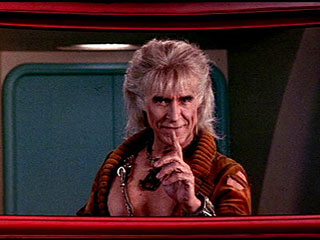 That's even more true with Star Trek, the origin of this Wrath of Khan analogy. Star Trek: The Motion Picture wasn't slow and plodding because it was introducing the movie audience to the Star Trek Universe... Gene Roddenberry's vision of the 23rd century had been on television non-stop since the series debuted in the 60s. It wasn't created to set up the "leaner, meaner" Star Trek II: The Wrath of Khan. No, ST:TMP began it's life as a pilot for the Star Trek: Phase II television series, which was scrapped when it was decided that bringing Trek to the big screen was more important than getting new episodes on the small one.
And when The Motion Picture's box office debut was met with criticism from critics and fans alike, lessons were learned and applied to the sequel. The Wrath of Khan simply represents a different, and more successful, take on the Star Trek mythos. The two movies were not created as part of some grand design to introduce the characters and the world in the first one, and then launch straight into the action in the second.
Mistakes were made and lessons were learned. That's why the second movie in a series is sometimes superior to the initial one, not because of what the initial one supposedly needs to accomplish.
Granted, a movie like X-Men does have a complex world to set up; Marvel's mutant universe can be impenetrable to outsiders if not presented correctly. But X-Men isn't lacking for action because it had to introduce the mutants and the world that hates them. It's lack of action stems from the small budget Singer was given to work with, due to the studio's lack of faith in the comic book franchise. When X-Men proved itself, Singer was given more money for X2, which itself was so successful that the studio ponied up even more dough for X3, which if nothing else provided us with some epic fight scenes.
Similarly, if the Fantastic Four sequel proves to be better than the original, it will be because someone learned from the mistakes that were made. The sequel needs to embrace the source material, rather than try to minimize the fantasy elements in a misguided attempt at realism. (And if the inclusion of Silver Surfer and Galactus is any indication, they certainly seem to be on the right track). And the same goes for Marvel's Incredible Hulk do-over. On a certain level, comic book superheroes will always be ridiculous. If you want to win over the audience and get them to suspend their disbelief, you need to make a rollicking good movie, not one that is apologetic and embarrassed by its source material, or that tries to bury its absurd elements under an increasingly unstable pile of pseudoscientific justifications. (I'm looking at you, Ang Lee. Throwing in starfish and genetic tampering from birth and God knows what else doesn't make the Hulk's origin any less ridiculous than Bruce Banner getting caught in a gamma bomb blast. It just makes your overwrought movie that much more tedious).
In discussing his proposed sequel for Superman Returns, Singer also invokes The Empire Strikes Back, which I think makes my point for me. The Star Wars Universe, I would argue, is even more complicated than the X-Men's world (which at least is set on Earth), yet Lucas had no trouble establishing it in Star Wars: A New Hope without skimping on the action. The reason that Empire is considered to be superior is not because it ramps up the action; if that were so, then Return of the Jedi would have to be considered the pinnacle of the original trilogy. Empire succeeds on its artistic merits.
Despite my disappointment with Superman Returns, I do hope that Singer is given the opportunity to make a sequel. He's shown what he's capable of with the first 2 X-Men movies (and if you want to see what he brought to them, you need only look at what's missing from X3), and he remains one of my favorite directors. I can only assume that his trotting out of the "traditional comic book movie wisdom" was due to his understandable defensiveness regarding the less-than-stellar reviews he had to suffer through all summer. Because when Singer insists that Superman Returns is exactly what the first movie in a new franchise needs to be, I can't help but hear Pee-Wee Herman, having just fallen off his bike, saying "I meant to do that!"